 Stratum
Stratum vs Jamovi & JASP
Jamovi and JASP are the popular free, open-source, R-backed statistics apps — the natural comparison when you're weighing paid against free on a Mac or Windows PC. Here's an honest, side-by-side look.
Jamovi and JASP are the two apps people mean when they ask, "is there a free alternative to paid stats software?" Both are free, both are open source, both are built on R, and both run on Mac, Windows, and Linux. Stratum is a paid app, so this comparison is about one question: what does the money buy that free does not?
Where Jamovi and JASP shine
Start with the obvious: they're free and open source, which removes the single biggest barrier to trying serious statistics — and for a student, a classroom, or a tight budget, that can settle the matter on its own. Both have friendly, approachable interfaces that lower the intimidation of a stats package. Both cover the classical toolkit — descriptives, t-tests, ANOVA, correlation, chi-square, regression — competently, with results computed through well-worn R packages. Both are widely used in teaching and backed by active communities. And JASP in particular is a leader in Bayesian methods, with a depth there that Stratum doesn't attempt to match, plus clean APA-formatted output that researchers value. None of this is faint praise — for a large share of everyday analysis, either app will do the job without costing a cent.
Two free apps, briefly
They're not interchangeable. JASP leans academic: its Bayesian analyses are a headline feature, its output is APA-styled and paper-ready, and its layout pairs each analysis with its results. Jamovi feels more like a spreadsheet you run analyses on, and its real trick is extensibility — a module library, and the R language underneath, lets you add methods the core doesn't ship. Both stop where their engine does: data held in memory, and charts built for the page rather than for a print-resolution export.
What the one-time price buys
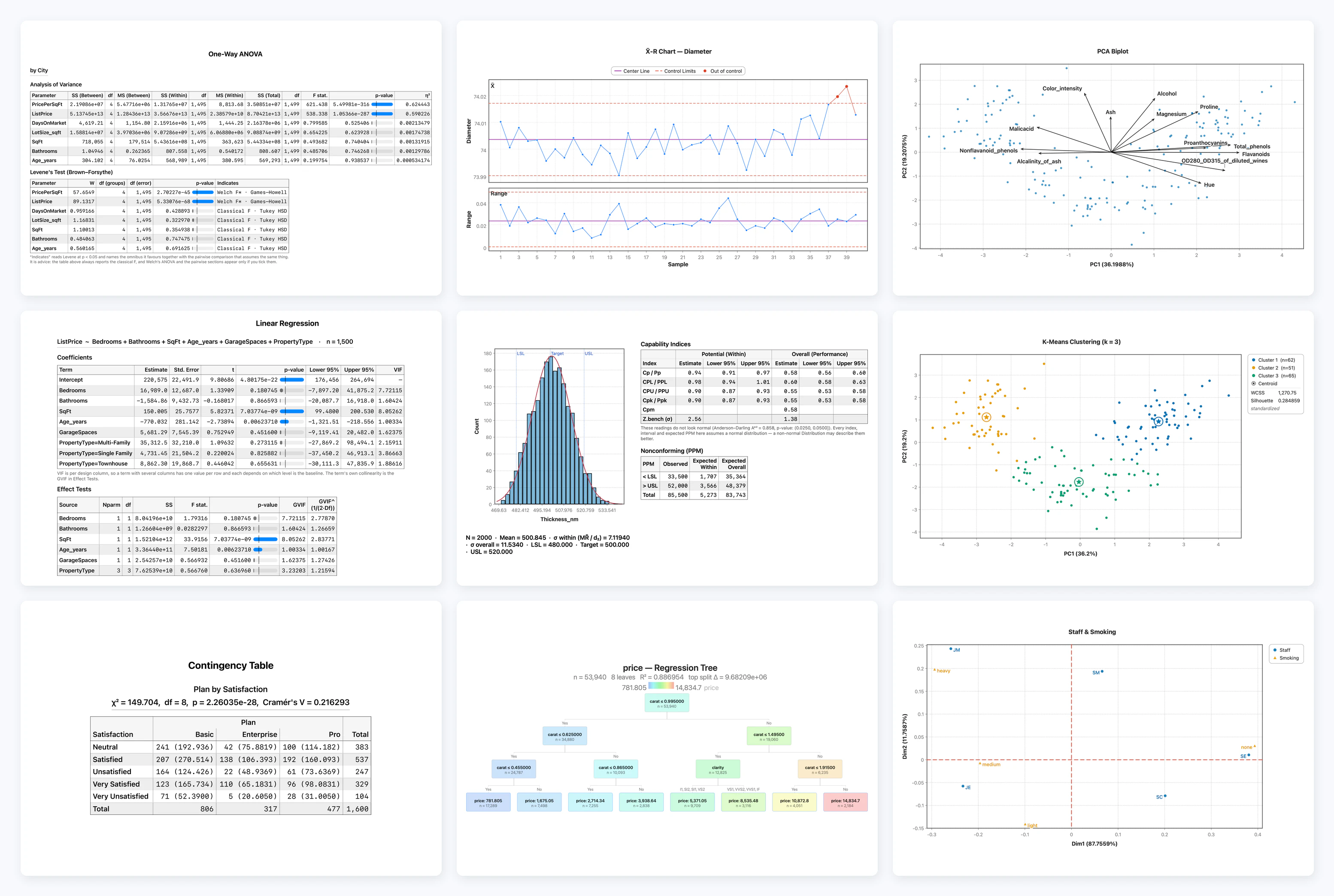
So what does paying for Stratum buy? Three things the free apps aren't built for. First, scale: Stratum's native engine handles up to about five million rows, where R-backed apps hold data in memory and slow down well before that. Second, a charts and data-visualization story — 30+ interactive charts, SPC control charts and process capability, and a polished report you can hand to someone. Third, a published validation record: Stratum's numbers are verified against R, the NIST StRD reference datasets, and SPSS, and that record is public. The open-source apps are inspectable by nature — a different, also-legitimate kind of trust — but Stratum ships the verification done for you. It's also native to Mac and Windows rather than one cross-platform toolkit rendered on both. Whether those are worth the price is exactly your call to make.
| Stratum | Jamovi | JASP | |
|---|---|---|---|
| Price | Paid, one-time ($119 / $249) | Free | Free |
| License | Commercial | Open source | Open source |
| Platforms | Native Mac & Windows (built to each) | Cross-platform (Mac / Windows / Linux) | Cross-platform (Mac / Windows / Linux) |
| Backed by | Native Swift/C# engine | R | R |
| Classical stats | Descriptives, t-tests, ANOVA + Tukey, MANOVA, correlation, chi-square, regression (VIF / Cook's D) | Solid, well-covered | Solid, well-covered |
| Bayesian methods | Not a Bayesian tool (frequentist + ML) | Available via module | Extensive — a signature strength |
| Charts | 30+ interactive (box, violin, density, Q-Q, Pareto, mosaic, control charts) | Analysis-linked plots (fewer chart types) | Analysis-linked plots, clean output |
| SPC / control charts + capability | Yes | Not a focus | Not a focus |
| Machine learning | PCA, clustering, decision trees, random forests, boosted trees | Via modules | Some (classification / regression modules) |
| Max data size | Up to ~5 million rows | In-memory (R); slows on large data | In-memory (R); slows on large data |
SPSS .sav import | Yes (1.4) | Yes | Yes |
| Validation record | Published — verified vs R, NIST StRD, SPSS | Open source; results run through R packages | Open source; results run through R packages |
| Report / export | Report PDF + charts PNG/PDF (RTF / APA-style coming) | Results export (PDF / HTML) | Results export incl. APA-formatted tables |
| Best for | Fast native everyday analysis at scale, charts, a trustworthy report | Free teaching & everyday classical stats, extensible via R | Free Bayesian + frequentist analysis, tidy APA output |
Two rows are parity, not victory, and worth calling out so the table isn't misread. Both Jamovi and JASP open .sav files too, so SPSS import isn't a Stratum-only win here. And all three run on Mac and Windows — the difference is that Stratum is built natively to each platform rather than released through a single cross-platform codebase, not that it reaches more platforms.
The core overlap
Set expectations honestly: for the bread-and-butter of applied statistics — descriptives, t-tests, one-way and factorial ANOVA, correlation, chi-square, and regression — all three tools will get you a correct answer. If that's the whole job, the free apps are not a compromise; they're a complete solution. The overlap is real and large, and pretending otherwise would waste your time. Stratum's case begins where that shared core ends: at data volume, at the breadth and interactivity of the charts, at machine learning sitting beside the classical tests, and at a report and a validation record you can put in front of someone else.
Trying it on your own data
You don't have to decide from a table. Stratum opens your .csv, .xlsx, and .sav files directly, so you can run your own analysis side-by-side with whatever free app you're already using and judge on your own data. If you're coming from SPSS files specifically, opening a .sav on Mac works the same way in all three.
Download Stratum See all features →
Frequently asked questions
Is Stratum free like Jamovi and JASP?
No — Stratum is a paid app (one-time, $119 / $249), where Jamovi and JASP are free and open source. Stratum's case is scale, charts, a validation record, and a native Mac-and-Windows experience; if those don't matter to you, the free apps are excellent.
What does JASP do that Stratum doesn't?
Bayesian statistics. JASP's Bayesian methods are a signature strength and are far deeper than Stratum's, which is a frequentist-plus-machine-learning tool.
Are Jamovi and JASP good enough for real work?
Yes. Both compute through mature R packages and cover the classical toolkit well. The question isn't whether they're capable — it's whether you need Stratum's scale, charting, reporting, and validation on top.
Do Jamovi and JASP run on Mac?
Yes, both are cross-platform (Mac, Windows, Linux). Stratum is built natively for Mac and Windows rather than shipped through one cross-platform toolkit.
Can I open an SPSS .sav file in all three?
Yes — Stratum (from 1.4), Jamovi, and JASP all read .sav files directly.
Which should I choose?
Free and Bayesian → JASP. Free and extensible with a data-grid feel → Jamovi. Large data, a deep charts-and-report story, and a validated native app you're willing to pay once for → Stratum.
Related comparisons: Stratum vs SPSS · Stratum vs JMP · Stratum vs Prism · Stratum vs Excel
Related: Stratum vs SPSS → · Best Statistics Software for Mac & Windows →